How a Remote Scottish Island Created the Trust System That Built American Banking

In the windswept Hebrides, off Scotland's western coast, sits the island of Islay. Today, it's famous for whisky distilleries and dramatic landscapes. But three centuries ago, this remote community of farmers and fishermen accidentally invented something that would help build America's financial system.
They just didn't know it at the time.
The Island Where Everyone Knew Everyone
In the early 1700s, Islay had maybe 8,000 residents spread across 240 square miles. No banks. No formal credit system. No way to borrow money except from your neighbors.
So the islanders developed something else: an intricate web of personal trust and mutual obligation that let them lend, borrow, and trade without ever putting anything in writing.
It worked like this: your reputation was your currency. If Hamish the fisherman needed grain seed but wouldn't have money until after the harvest, Duncan the farmer might front it — not because of any contract, but because everyone knew Hamish always paid his debts.
The system was enforced by the community itself. Stiff someone, and word spread across the island within days. Try to borrow again, and doors would close. In a place where you might need help surviving the next winter, reputation wasn't just important — it was everything.
The Great Migration
Starting in the 1730s, economic pressures and land disputes drove waves of Scots to emigrate to America. Many Islay families packed up and sailed west, settling in places like North Carolina, Pennsylvania, and Virginia.
They brought few possessions, but they carried something invisible: a sophisticated understanding of how trust-based commerce could work.
"The Scots who came to America weren't just farmers and craftsmen," explains Dr. Margaret Thornton, a historian at Davidson College who studies Scottish-American immigration patterns. "They brought social technologies — ways of organizing economic relationships that didn't exist in formal institutions yet."
Building Commerce Without Banks
In colonial America, formal banking barely existed. The first commercial bank wouldn't open until 1781. So early American communities had to figure out how to lend money, extend credit, and facilitate trade without institutional support.
Enter the Scottish emigrants with their island-tested system.
In places like the Cape Fear Valley in North Carolina, where many Islay families settled, these informal trust networks began connecting different communities. A merchant in Wilmington might extend credit to a farmer in Cross Creek (now Fayetteville) because both were vouched for by mutual acquaintances in the Scottish community.
The system scaled up organically. Trust relationships that started between individuals grew into networks spanning multiple towns, then regions.
The Reputation Ledger
What made this system work was information flow. In small Scottish communities, everyone knew everyone's business. In America, the emigrants had to recreate that knowledge network across much larger distances.
They did it through letters, traveling merchants, and church connections. Presbyterian congregations, in particular, became crucial nodes in the trust network. Ministers often served as informal references, vouching for the character and reliability of their parishioners.
"If someone from the Islay community in North Carolina wanted to do business with Scots in Pennsylvania, they'd often route the introduction through church connections," says Thornton. "The minister's word carried enormous weight."
From Handshakes to Institutions
As American commerce grew more complex, these informal systems gradually became formal ones. The trust networks that connected Scottish communities became the foundation for early American banks, insurance companies, and trading houses.
Many of the practices that seem fundamental to American banking — character references, community vouching, relationship-based lending — trace back to these Scottish social technologies.
The Bank of North America, founded in 1781, explicitly used character references and community standing as lending criteria. Early insurance companies relied on local agents who knew their clients personally. Even the New York Stock Exchange, established in 1792, operated on principles of personal trust and reputation.
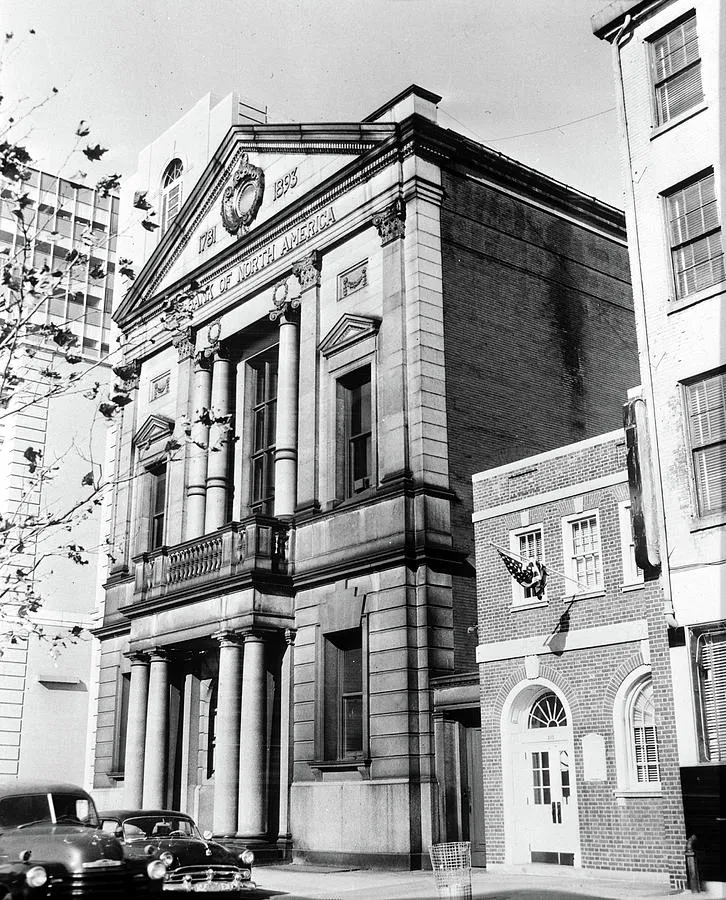 Photo: Bank of North America, via images.fineartamerica.com
The DNA of American Finance
You can still see echoes of the Islay system in modern American finance. Community banks that emphasize local relationships. Credit unions built around shared bonds. Even venture capital, where personal networks and reputation matter as much as business plans.
"The idea that commerce should be based on personal relationships and community trust — that's not universally accepted around the world," explains Dr. James McMillan, an economic historian at the University of Edinburgh. "But it became deeply embedded in American business culture, partly through these Scottish immigrant communities."
The Island Connection Today
Islay itself has about 3,000 residents now, and its economy runs on whisky tourism rather than subsistence farming. But elements of the old trust system persist.
Local businesses still operate on handshake deals. Fishermen share equipment and knowledge without formal contracts. The island's eight whisky distilleries coordinate production schedules and share resources in ways that would puzzle MBA students but make perfect sense to anyone who understands how small communities actually work.
Lessons from the Past
The Islay story suggests something interesting about how financial systems develop. Before algorithms and credit scores, before institutional lending and regulatory frameworks, there was simply human judgment about character and community standing.
That system had flaws — it could exclude outsiders and perpetuate existing power structures. But it also enabled commerce and economic development in situations where formal institutions didn't exist or couldn't be trusted.
As modern finance becomes increasingly automated and impersonal, there's something worth remembering about the Scottish islanders who figured out how to build prosperity on nothing more than their word and their neighbors' trust.
After all, even in an age of credit scores and blockchain, most business still comes down to the same basic question those Islay farmers asked three centuries ago: can I trust this person to keep their promises?