Before Lloyd's of London, Philadelphia Invented Modern Insurance — And Almost Nobody Remembers
The Story That Got Written Out of Financial History
Ask most people where modern insurance was invented, and they'll say London. Specifically, they'll say Lloyd's — that storied institution born in a coffeehouse on Tower Street where merchants and ship captains gathered to spread the risk of losing a vessel at sea. It's a great story, and it's mostly true.
But it's not the whole story.
Because in 1752, a group of Philadelphia merchants and property owners did something that Lloyd's hadn't quite managed: they created a mutual insurance company — one where the policyholders were also the risk-sharers — and used it to protect homes and buildings from fire. The institution they built, the Philadelphia Contributionship for the Insurance of Houses from Loss by Fire, is still operating today. It is the oldest continuously operating insurance company in the United States. And almost nobody outside of Pennsylvania knows it exists.
Benjamin Franklin's Lesser-Known Legacy
You probably know Benjamin Franklin as the kite-and-key guy, the Founding Father, the face on the hundred. What gets less airtime is his role as one of America's earliest financial innovators.
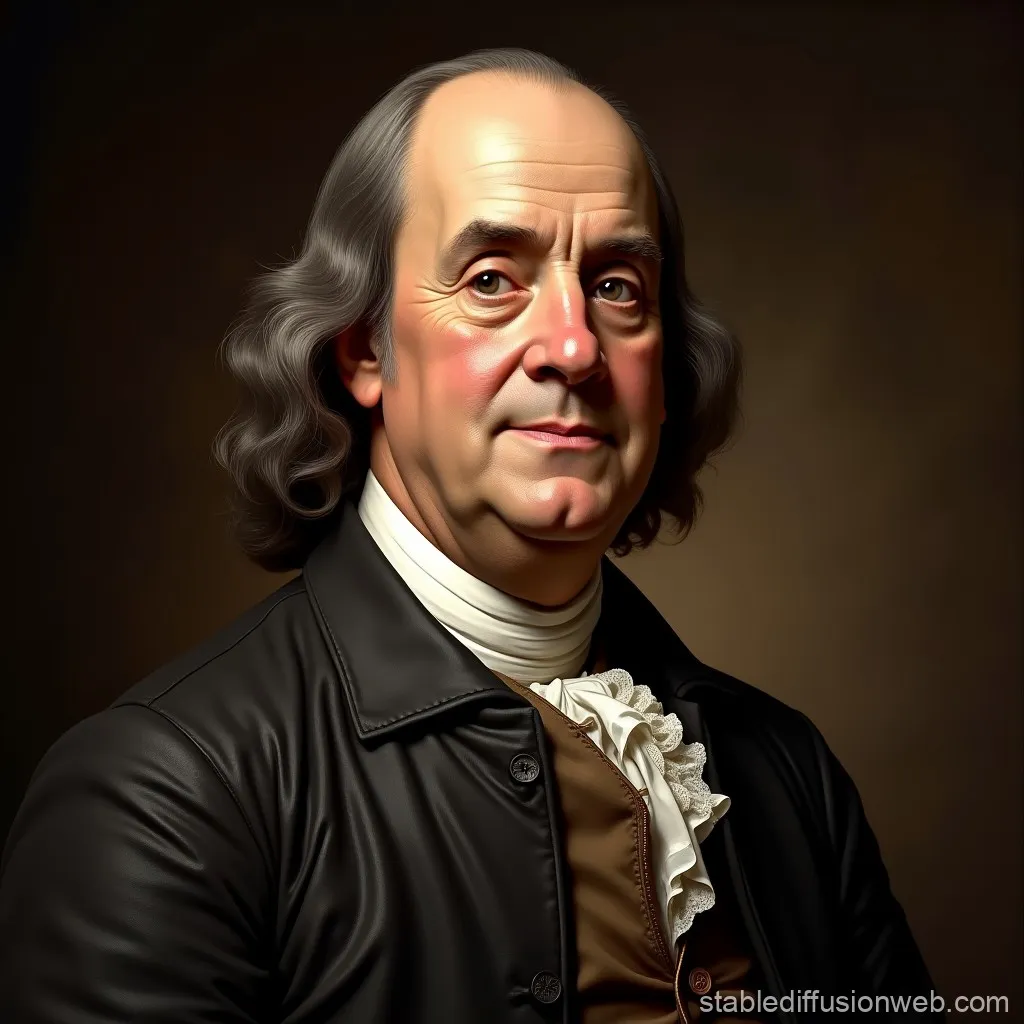 Photo: Benjamin Franklin, via imgcdn.stablediffusionweb.com
Franklin was a co-founder of the Philadelphia Contributionship. He understood, with characteristic practicality, that individual households couldn't absorb the catastrophic cost of a house fire on their own — but that a community of property owners, each contributing a small amount into a shared pool, could collectively protect everyone. The risk gets distributed. The individual exposure shrinks. The math works.
This was genuinely radical thinking in colonial America. Most people dealt with financial disaster the old-fashioned way: they didn't, and they lost everything. Franklin's group formalized the idea that neighbors could pool their vulnerability and come out stronger together.
The Contributionship issued its first policies using a distinctive logo — four interlocked hands — which members would display on their homes as a mark of coverage. It became known as the Hand-in-Hand. Fire companies, which were also often volunteer organizations in that era, would look for the mark when responding to blazes. Whether this influenced how urgently they responded is a matter of historical debate, but the symbolism was clear: membership in a mutual network meant something.
Why London Almost Claimed the Credit
Here's where it gets interesting. Lloyd's of London was already well-established by 1752, and British financial culture had a way of absorbing and rebranding innovations that originated elsewhere. American commercial history from the colonial period is littered with ideas that either got attributed to European institutions or simply faded from the record as the young nation focused on other things — like, say, revolution and nation-building.
 Photo: Lloyd's of London, via i.pinimg.com
The Philadelphia model was genuinely different from what Lloyd's was doing. Lloyd's operated on an underwriting basis: wealthy individuals (called Names) would agree to cover a portion of a specific risk in exchange for a premium. If the ship sank, they paid. If it didn't, they kept the premium. It was transactional.
The Contributionship's mutual model was something else. Members weren't just customers. They were co-owners of the risk pool. Profits stayed in the pool. The incentive wasn't to collect premiums and minimize payouts — it was to keep the community of policyholders financially whole. That distinction still matters enormously, and it's why mutual insurance companies have historically paid out claims at different rates than stock insurance companies.
The Mutual Model Never Really Went Away
Fast forward to today, and the mutual insurance structure that Franklin's group pioneered is alive in some of the most financially resilient corners of American life — even if people don't always recognize it.
Companies like State Farm, Mutual of Omaha, and USAA are mutual insurers or structured along similar principles. Farm Bureau insurance networks operate on cooperative models deeply influenced by the mutual tradition. Small regional mutuals — the kind that cover rural communities, agricultural operations, and tight-knit neighborhoods — often outperform their corporate counterparts in claims satisfaction, precisely because their incentive structure is different.
There's also a quieter comeback happening in the form of risk retention groups and captive insurance arrangements, where businesses in the same industry pool their liability exposure rather than buying coverage from a commercial carrier. The mechanics are more complex, but the core idea — neighbors sharing risk — would have been immediately recognizable to Franklin and his Philadelphia colleagues.
What This Buried History Actually Tells Us
The Philadelphia Contributionship story is more than a trivia footnote. It's a window into how financial innovation actually happens — not in the gleaming towers of established institutions, but in practical responses to real problems faced by real communities.
Franklin didn't set out to invent modern insurance. He set out to solve the problem of his neighbors losing their homes to fire. The institution that emerged from that practical thinking has now been operating continuously for over 270 years.
Lloyd's gets the fame. Philadelphia built something that lasted.
Maybe that's the more interesting story.