Forget the Bank: The Ancient Money-Sharing System Your Neighbors Are Using to Fund Cars, Renovations, and Fresh Starts
The Money Meeting Nobody Talks About
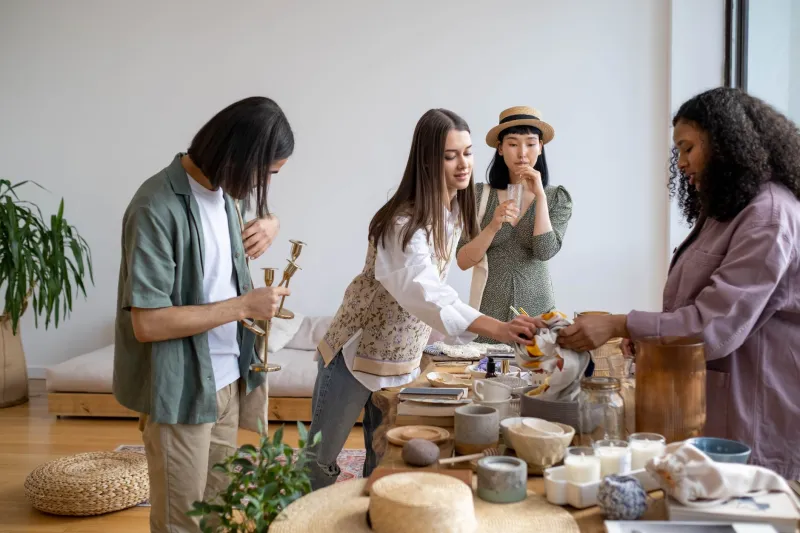
Somewhere in your city right now, a group of people is probably sitting around a kitchen table — or a group chat — pooling their money together. No bank involved. No credit check. No interest rate buried in the fine print. Just a circle of people who trust each other enough to take turns being the one who gets the pot.
This isn't some fringe experiment or a crypto-adjacent scheme. It's one of the oldest financial systems on earth, and it has a name: a rotating savings and credit association, or ROSCA.
Chances are you've never heard that term. But chances are also good that someone in your family has participated in one — maybe under a different name. Tanda in Mexican-American communities. Susu in West African and Caribbean circles. Hui in Chinese and Vietnamese networks. Paluwagan in Filipino communities. Chit fund in South Asian neighborhoods.
The names change. The structure is almost always the same.
How It Actually Works
The mechanics are beautifully simple. A group of people — anywhere from five to fifty, though smaller groups are more common — agree to contribute a fixed amount of money on a regular schedule. Weekly, biweekly, monthly. Whatever the group decides.
Each cycle, the entire pot goes to one member. The rotation continues until everyone has received the pot once. Then the group either disbands or starts a new cycle.
Say ten people each contribute $200 a month. Every month, one member receives $2,000. Over ten months, everyone gets their turn. Nobody paid interest. Nobody filled out an application. The only collateral is social trust.
The person who receives the pot first essentially gets an interest-free loan — they've only contributed one month's payment but received ten months' worth. The person who receives it last has essentially been saving with the group. The order is often determined by need, negotiation, or random draw, depending on the group's culture and rules.
A History That Predates Modern Banking
ROSCAs aren't a workaround invented because modern finance failed people. They're older than modern finance itself.
Historians have traced versions of this system back centuries across Asia, Africa, the Caribbean, and Europe. When immigrant communities arrived in the United States — wave after wave, from the 1800s onward — they brought their money-sharing traditions with them, often because formal banking was unavailable, discriminatory, or simply untrustworthy.
Japanese immigrants in early 20th century California used a version called tanomoshi to fund businesses when banks refused them loans. African-American communities in the South organized susu circles as a direct response to being excluded from white-owned financial institutions. These weren't informal charity arrangements — they were sophisticated, community-engineered financial infrastructure.
And they worked. Businesses got started. Houses got bought. Children went to college. All without a bank's approval.
The Legal Question Everyone Asks
Here's where people often get nervous: is this legal?
In most cases, yes — with important caveats. Private ROSCAs among friends, family, or trusted community members generally operate in a legal gray zone that the government doesn't heavily regulate. As long as no one is charging interest, no one is running the group as a for-profit enterprise, and participation is genuinely voluntary, most informal ROSCAs fly well under the regulatory radar.
The complications arise when organizers start charging fees for running the group, when the pool gets very large, or when the arrangement starts to look like a financial product being sold to strangers. At that point, state money transmission laws and securities regulations can come into play.
Some modern ROSCA platforms — apps like Esusu and Kickfurther — have built formal, compliant versions of the concept that also report payments to credit bureaus, helping participants build credit scores alongside their savings. That's a meaningful innovation for people who've been locked out of the credit system.
Why It's Coming Back Now
America's relationship with traditional banking has gotten complicated. Interest rates on savings accounts spent years hovering near zero while banks collected fees for everything from overdrafts to paper statements. Credit card interest rates have climbed above 20 percent for many borrowers. Personal loan applications can feel like an interrogation.
Meanwhile, trust in institutions generally — financial and otherwise — has taken a sustained hit. People are increasingly looking for alternatives that feel more human, more local, more accountable.
ROSCAs check a lot of those boxes. They're built on relationships, not algorithms. They reward consistency rather than credit scores. And they create a social accountability that, paradoxically, often produces better repayment behavior than formal loans. Nobody wants to be the person who let their neighbors down.
Younger Americans are discovering this through community finance groups on Reddit, through immigrant family networks, and through a growing number of fintech platforms that are essentially modernizing an ancient idea.
Starting One Yourself
If you're curious about joining or organizing a ROSCA, the fundamentals haven't changed much in centuries:
Start small and start local. The system runs on trust, and trust takes time to build. A group of five to eight people who know each other well is a better starting point than a large group of acquaintances.
Put the rules in writing. Even among friends, written agreements about contribution amounts, payout schedules, and what happens if someone misses a payment prevent misunderstandings.
Decide on the order early. Whether you use random draw, negotiation, or need-based assignment, settle this before the first pot is collected.
Keep it manageable. The contribution amount should be meaningful enough to matter but comfortable enough that missing a payment isn't a crisis for anyone.
The Most Human Financial Tool Ever Made
What's remarkable about ROSCAs isn't just that they work. It's that they've worked across wildly different cultures, economies, and centuries — without lawyers, without credit bureaus, without apps.
They persist because they solve something that formal finance often can't: the need for a financial system that actually knows you. One that's built on the kind of trust you can look in the eye.
In an era of algorithmic lending and faceless fintech, that might be the rarest financial product of all.